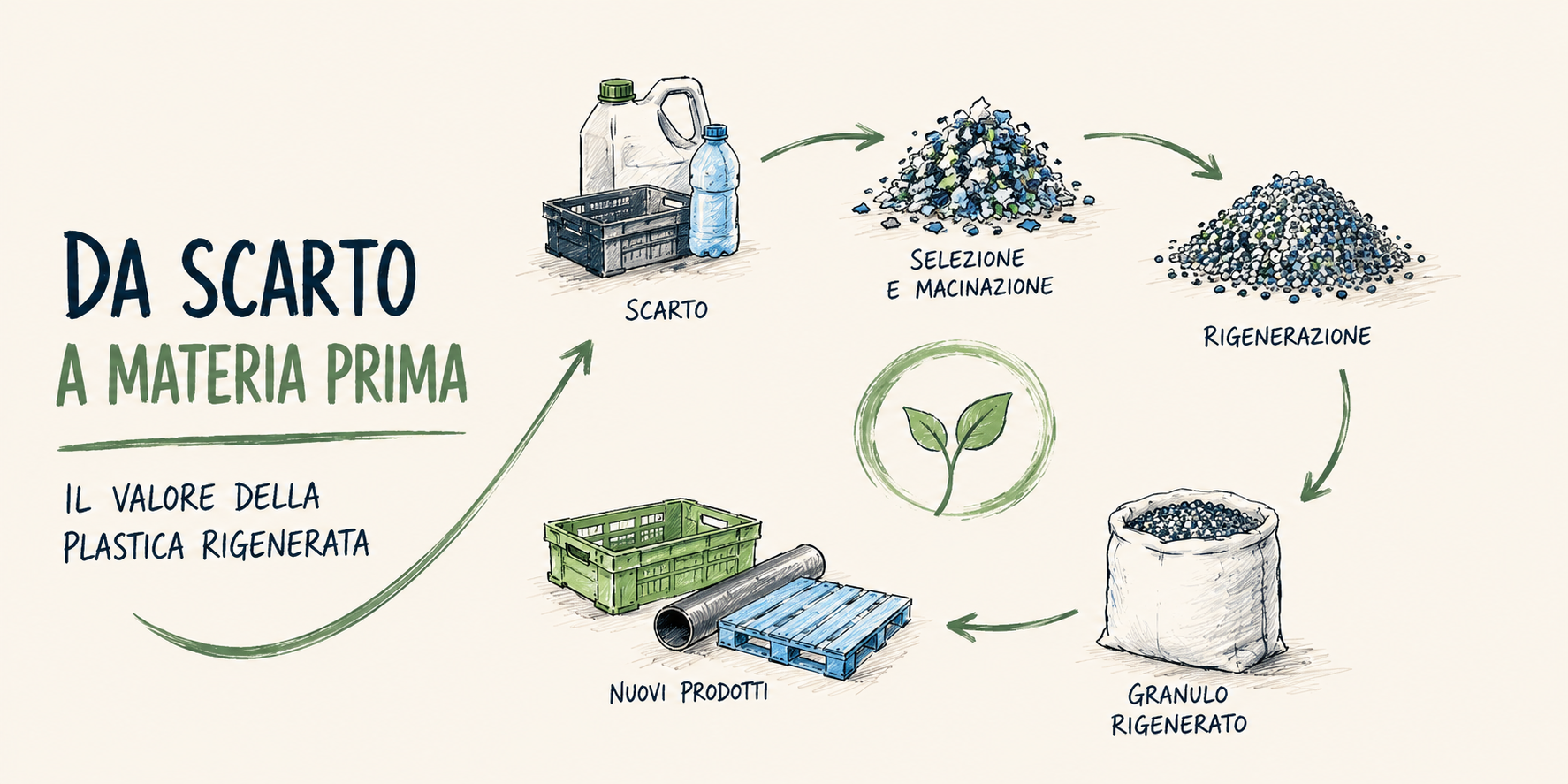
When we talk about plastic, the word “waste” is often associated with the end of a journey.
For the recycling industry, however, it can represent the beginning of a new cycle.
A plastic material that has reached the end of its first use is not necessarily a material without value. If properly selected, processed and transformed, it can once again become a raw material intended for the production of new products.
This, essentially, is the principle behind recycled plastic.
What does it mean to recycle a plastic material?
Recycling plastic means recovering a material which, due to its characteristics, origin or previous use, is no longer employed for its original purpose and transforming it again into a material that can be used in industrial processes.
The process can include several stages: collection and sorting, possible grinding, material inspection, treatment and subsequent extrusion. At the end of the process, the material is generally transformed into granules, a form that makes it possible to handle, dose and reuse it in standard production processes.
But the point is not simply to transform waste into granules.
The real value lies in knowing the material you have available and understanding where and how it can be used.
Not all recycled plastics are the same
Saying “recycled material” does not mean identifying a single type of product.
Two materials belonging to the same family can have very different characteristics depending on their origin, composition, treatments undergone and the process through which they have been recycled.
This applies, for example, to materials such as PP, PE and PVC, which can be available in different grades and with specific characteristics.
For those who need to process a plastic material, therefore, the question should not simply be:
“Is it recycled?”
But rather:
“Is it the right material for my application?”
This is where technical parameters, consistency of quality, mechanical properties, flow characteristics, colour and many other variables come into play, all of which must be assessed according to the final product.
Recycled material is not simply a cheaper alternative
Price is certainly one of the factors that can make recycled raw material attractive, but reducing its value to an economic issue alone would be limiting.
Using recycled material primarily means reintroducing into the production cycle a material that might otherwise become waste, reducing the need to rely exclusively on virgin raw material.
Naturally, this does not mean that recycled material can indiscriminately replace virgin material in every application.
Every product has specific requirements, and every production process requires particular characteristics.
The right choice therefore consists in finding the right balance between required performance, material characteristics, production process, and economic and environmental objectives.
Quality comes from knowledge
In the world of recycled plastics, knowing the raw material is essential.
It is not enough to know that a granule is “PP” or “PE”. It is necessary to understand its characteristics and, above all, its behaviour within the production process for which it is intended.
This is why material selection, collaboration with qualified partners and experience built up over time play an important role.
It is a part of the work that often goes unnoticed when simply looking at a bag of granules, but it can make the difference between a material that is suitable for a particular application and one that is not.
Daloga and recycled plastic materials
DALOGA was founded in 2007 in the plastics industry, initially specialising in PVC compounds.
Over the years, its activities have expanded to other polymer families, including PP and PE, while maintaining a characteristic that remains central to the business today: the decision to work with recycled plastic materials.
Behind every granule lies a different story: an origin, a recovery process, technical characteristics and a possible new industrial destination.
The role of those operating in this sector is also to connect these characteristics with the requirements of those who will use the material.
Because transforming waste into granules is only one part of the process.
Giving it a new industrial function is what restores its value.
A new cycle
Plastic can have more than one life.
The transition from waste to raw material is neither automatic nor the same for every material. It requires processes, expertise, selection and knowledge of applications.
But it is precisely this possibility of re-entering the production cycle that makes the world of recycled plastic materials so interesting.
And this is where we want to start.